
Most purchase managers sourcing Eplerenone API know to ask for a CEP. Fewer know what to do when they actually have one in hand — what it covers, what it leaves open, and what questions to ask before a Letter of Access gets issued. This article is for the latter group.
Why Eplerenone Is a Technically Demanding Molecule to Source
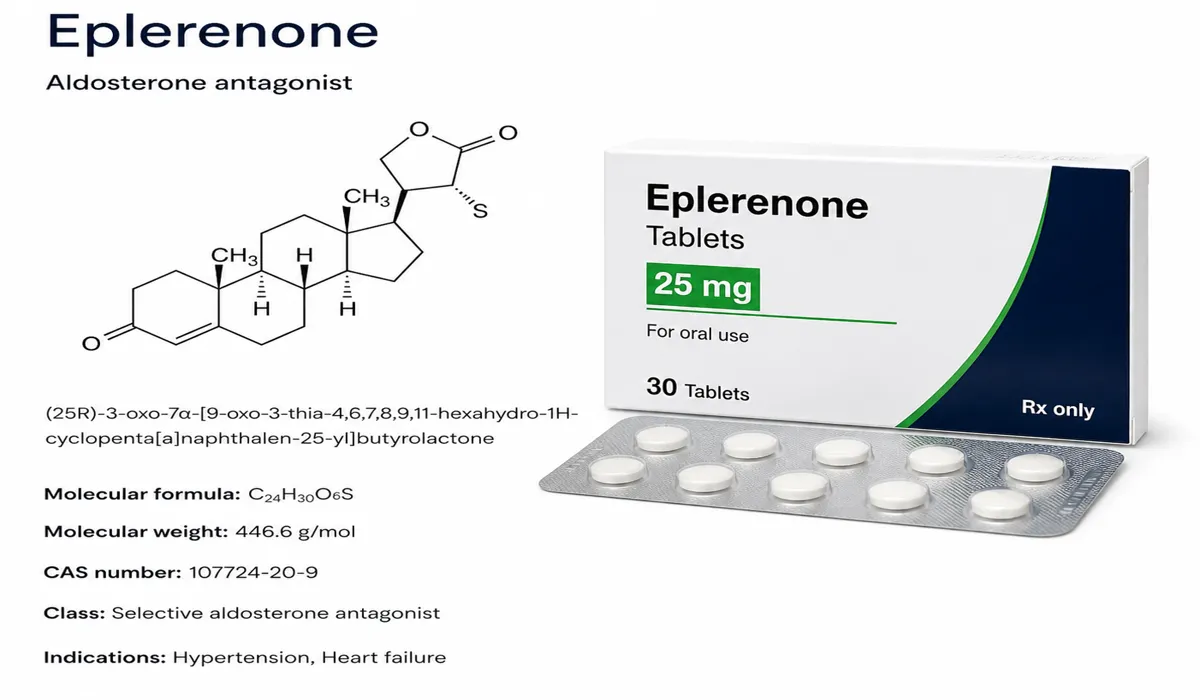
Eplerenone (CAS 107724-20-9) is a steroidal selective aldosterone receptor antagonist. It is structurally derived from spironolactone but engineered for high mineralocorticoid receptor selectivity, which is precisely what makes it clinically attractive — and synthetically difficult.
The synthesis route involves a multi-step transformation starting from 11α-hydroxy-7α-(methoxycarbonyl)-3-oxo-17α-pregn-4-ene-21,17-carbolactone as the principal starting material. The key challenge in manufacturing Eplerenone to pharmacopoeial grade is controlling side reactions at the steroid ring C — specifically:
- Epimerization at the C-7 asymmetric centre (producing the 7β-epimer)
- Epoxidation (generating Impurity B and E)
- Lactonization (generating Impurity A — the 7α,9:21,17-dicarbolactone)
- Chlorination during intermediary steps (producing 9,11-dichloro derivatives)
These are not theoretical concerns. Published research on multigram-scale Eplerenone synthesis has documented that several of these impurities — particularly Imp. A (dicarbolactone), Imp. B (11,12-epoxyester), and Imp. E (regioisomeric epoxyester) — are structurally difficult to remove from the final API and require validated HPLC methods to control reliably.
What this means for procurement: the impurity profile of Eplerenone is route-dependent. Two suppliers with CEPs may have meaningfully different impurity signatures based on their synthesis routes. Your dossier and analytical methods need to reflect your specific supplier’s profile — not a generic Ph. Eur. specification.
What the European Pharmacopoeia Monograph Actually Tests
The EP monograph for Eplerenone specifies the following:
- Identification: IR and comparative HPLC retention time
- Related substances: RP-HPLC on C18 column, gradient conditions; detection at 240 nm
- Specified impurities A and B with individual limits
- Total impurities limit for unspecified related substances
- Water content: Karl Fischer titration
- Sulfated ash
- Assay: RP-HPLC, purity ≥ 98.5% on anhydrous basis
What the monograph does not specify:
- Polymorphic form (Eplerenone is known to exist in multiple polymorphs; only one is bioavailable for oral dosage forms)
- Particle size distribution (critical for tablet dissolution performance)
- Residual solvents (these are route-specific and covered by ICH Q3C, not the EP monograph)
- Genotoxic impurities (covered by ICH M7 — supplier responsibility, not pharmacopoeial)
This is a critical point. A CEP confirms Ph. Eur. monograph compliance. It does not confirm that the API is suitable for your formulation.
What the EDQM Actually Evaluates Before Issuing a CEP
The EDQM’s review goes beyond the monograph. Before granting a CEP, EDQM assesses:
- The full synthesis route — starting materials, reagents, intermediates, reaction conditions
- Impurity control strategy — how each specified and unspecified impurity is controlled at each manufacturing step, not just at the final release stage
- Analytical method validation — the HPLC methods used must be validated and capable of separating Eplerenone from all known process impurities
- ICH Q3D elemental impurity assessment — if any metallic catalysts are used in synthesis
- ICH M7 genotoxic impurity assessment — EDQM now integrates M7 risk management summary requirements into CEP dossiers; any reagents with structural alerts for mutagenicity must be assessed and controlled
Once issued, any significant change to the synthesis route requires a new CEP application — not merely a variation. This includes changes to: starting material manufacturer, reaction conditions that alter the impurity profile, or introduction of a substantially different route even if the final specification remains unchanged.
For purchase managers: this means a CEP number alone is not sufficient. Always verify the current revision of the CEP, confirm that the manufacturing site on the certificate matches the site you are auditing, and check whether any post-issuance changes have been filed with EDQM.
How to Use a CEP in Your MAA — and Where Gaps Remain
When your supplier provides a CEP, they also issue a Letter of Access (LoA). This allows you to reference the CEP’s restricted content (the EDQM-assessed manufacturing details) in your Marketing Authorisation Application (MAA) dossier without needing to submit a full ASMF.
In practice, your Module 3 submission will include:
- A copy of the current CEP in Section 3.2.R
- Batch analysis results demonstrating conformance with the Ph. Eur. specification in Section 3.2.S.4.4
- Any additional controls not covered by the CEP — typically in Section 3.2.S.3.1
That last point matters. The EMA’s own Q&A guidance on CEP use confirms that polymorphic form, particle size, and re-test period are not covered by the CEP and must be documented separately by the MAA applicant. If your formulation is sensitive to particle size (as tablet dissolution of Eplerenone can be), this data must come from your own qualification testing — not the CEP.
A supplier who understands this and can provide micronisation specifications, polymorph characterisation data (XRPD), and ICH-compliant stability data alongside the CEP is materially more valuable than one who hands over the certificate and considers the job done.
The Supplier Qualification Questions That Actually Matter
Beyond the standard GMP certificate checklist, here is what to probe during Eplerenone API supplier qualification:
On the CEP:
- What is your current CEP revision number and date? (Verify independently via the EDQM public database)
- Has any post-approval change been filed with EDQM in the last 24 months? What was the nature of the change?
- Does your CEP cover all steps of synthesis, or are any steps performed at a contracted third-party site?
On impurity control:
- Which of the EP Appendix impurities (A, B, D, E, F, G) are detected in your standard batches, and at what typical levels?
- Do you have an ICH M7 assessment on file for your synthesis route? Have any reagents with structural alerts been identified?
- Have you identified any route-specific impurities beyond those listed in the EP monograph? How are these controlled?
On analytical methods:
- Is your HPLC method for related substances validated per ICH Q2(R1)?
- What is your system suitability criterion for resolution between Eplerenone and Impurity A / Impurity B?
- Do you use a chiral HPLC method to control the 7β-epimer (Impurity C)?
On physical form:
- What polymorphic form does your Eplerenone crystallise in? How is this controlled and verified (XRPD, DSC)?
- What is the typical particle size distribution (D10/D50/D90) of your released batches? Is micronised grade available?
On stability and re-test period:
- What re-test period is supported by your ICH stability data?
- Under what storage conditions (25°C/60% RH or 30°C/65% RH)?
- Do you have accelerated and stress degradation data available?
JPN Pharma’s Eplerenone API
JPN Pharma manufactures Eplerenone to IP (Indian Pharmacopoeia) standard at our Tarapur facility and holds a CEP for Eplerenone, enabling direct referencing in European marketing authorisation dossiers.
Our regulatory documentation package includes:
| Document | Status |
|---|---|
| CEP (EDQM) | Held — LoA available on request |
| WHO-GMP Certificate | Current |
| Written Confirmation (WC) | Certified |
| CoA (per released batch) | Available |
| ICH Stability Data | Available on request |
| Impurity Profile (EP impurities A, B, E) | Available on request |
| Polymorph characterisation data | Available on request |
We manufacture across three plants under the JPN Group, with our Eplerenone production based at our primary Tarapur site, approximately 80 km from Mumbai.
Summary: What to Verify Before Committing to an Eplerenone API Supplier
| Checkpoint | What to Ask |
|---|---|
| CEP validity | Current revision, manufacturing site match, EDQM public database verification |
| Synthesis route | Route-specific impurities beyond EP monograph, M7 status |
| Analytical control | HPLC method validation, chiral method for C-7 epimer |
| Physical form | Polymorph, PSD — critical for formulation performance |
| Stability | Re-test period, storage conditions, stress data |
| Regulatory support | LoA issuance, ASMF support if needed for non-EU markets |
A CEP is the entry ticket — not the finish line — for Eplerenone API qualification. The suppliers worth shortlisting are those who can answer all of the above without hesitation.
Interested in requesting JPN Pharma’s Eplerenone technical package? Contact our regulatory and sales team at info@jpnpharma.net or visit our Eplerenone product page for specifications and documentation details.
JPN Pharma Pvt. Ltd. is a WHO-GMP and CEP certified manufacturer of Active Pharmaceutical Ingredients and Drug Intermediates, based in Mumbai, India, with over 30 years of experience in global API supply.